Intro
From the jagged indie riffs of Whatever People Say I Am, That’s What I’m Not to the seductive slow-burn guitar tones of AM, Arctic Monkeys have built one of the most distinctive sonic identities in modern rock. Their sound feels simultaneously simple and intricate, raw yet refined, lo-fi but intentional, unpredictable but unmistakable. Fans hear a guitar tone and instantly know: that’s Arctic Monkeys.
But what exactly creates that sound? It’s not just the guitars. It’s not just the amps. It’s not just the producers. It’s the synergy between Alex Turner, Jamie Cook, Matt Helders and Nick O’Malley, along with the rooms, mics, pedals and production philosophies behind each era.
Across this deep-dive, we’ll break down the exact components of the band’s tone evolution: the instruments they used, the amps and pedals shaping their identity, and the studio magic added by iconic producers like James Ford, Josh Homme and Alan Smyth. Whether you're a musician chasing their tone, a fan fascinated by their craft, or someone wanting the AM noir sound recreated live, this guide gives you the full blueprint.
(If you’d like to hear these tones performed live, you can book Artificial Monkeys, the UK’s leading Arctic Monkeys tribute.)
Early Sheffield Sound: Raw, Fast and Indie
The earliest Arctic Monkeys recordings were made with budget gear, borrowed amps and guitars that would make modern gearheads raise an eyebrow. But this was the magic of their early sound. It wasn’t polished, it wasn’t expensive, it wasn’t refined. It was powerful.
Low Budget Gear That Built a Revolution
In their early days (2003 to 2005), the Monkeys weren’t chasing boutique pedals or luxury guitars. They were teenagers using whatever they could get their hands on:
- Squier and Epiphone guitars
- Cheap practice amps
- Basic distortion pedals
- Whatever studio mics were available
Alan Smyth, who engineered some of their early demos, described their gear as “cheap but effective.” That raw edge is exactly why songs like Fake Tales of San Francisco hit so hard. Turner often used a Squier Strat or cheap Les Paul copies, while Cook leaned on basic Telecasters, giving them bright, sharp tonal attack ideal for tight riffing.
Overdrive, Speed and Tight Rhythms
The early Monkeys sound revolved around:
- Fast, upbeat chord stabs
- Sharp double stops
- Thin overdrive
- Minimal effects
Their playing was full of youthful urgency. No reverb clouds, no ambient textures. Just plug in, turn up and play fast. The guitars weren’t huge; they were tight and dry, leaving room for Turner’s rapid-fire storytelling and Helders’ explosive drumming.
Producer Alan Smyth’s Early Influence
Smyth’s engineering philosophy was simple:
- Keep it dry
- Keep it tight
- Keep it close
- Keep it honest
He used straightforward microphones and close miking techniques to capture the rawness of the band. There was no production gloss, only clarity and energy. This shaped the signature early tone: garage rock directness with indie rock detail.
Favourite Worst Nightmare: Sharper Riffs and Tighter Tones
When Favourite Worst Nightmare arrived in 2007, fans immediately noticed the evolution. The guitars were sharper, brighter, faster and more aggressive. This wasn’t teenage chaos anymore, it was controlled firepower.
Brighter Amps and Faster Picking
Jamie Cook upgraded his gear significantly during this era. His tone became:
- Brighter
- Punchier
- More mid driven
- More articulate
This came from a combination of:
- Fender Telecasters
- Orange AD30 amps
- Tighter pick attack
Songs like Brianstorm, Teddy Picker and D is for Dangerous show how razor sharp the guitar work became during this period.
The Rise of the Fender and Orange Combo
This era cemented the guitar rig that many fans associate with the mid 2000s Monkeys:
- Fender guitars (Telecasters and Strats) into
- Orange amps (AD30, Rockerverb)
Orange amps delivered:
- Crunchy mids
- Immediate attack
- Tight low end
- Classic British bite
This rig became iconic and is still copied today by thousands of guitarists chasing the FWN sound.
Studio Polish Meets Live Aggression
The production team sharpened everything on this album:
- Double tracked guitars
- More precise panning
- Tighter compression
- Brighter EQ curves
The result was a sound that felt furious but clean, like chaos in HD. The youthful messiness of the debut became something more refined. Still energetic, but executed with more skill.
The band also learned to use space more effectively. Even when the guitars were fast and busy, they avoided becoming muddy.
What Makes This Era Unique?
- Fast palm muted stabs
- Angular riffs
- Tight rhythmic interplay
- Brighter tones
- Aggressive picking
This sound pushed Arctic Monkeys from indie hype to a technically impressive, maturing rock act. It also set the path for the darker tonal shift that would arrive on Humbug.
Humbug: Heavy, Dark and Desert Rock Influence (2009)
When Arctic Monkeys recorded Humbug with Josh Homme in the Mojave Desert, everything changed. Their songwriting, their tone, their creative instincts and most importantly their guitar sound took a dramatic new direction. Gone were the bright, spiky indie riffs. In came darker fuzz, slower grooves and brooding atmosphere.
Josh Homme’s Production Stamp
Homme introduced the band to a completely new tonal philosophy built around:
- Thicker distortion
- Lower tunings
- Darker EQ curves
- Tube saturation
- More space in the arrangements
It wasn’t about playing more, it was about playing heavier, slower and deeper. Turner and Cook embraced desert rock elements such as:
- Wide intervals in riffs
- Slower vibrato
- Warmer, bassier tones
- Fuzz pedals instead of thin overdrive
Songs like Crying Lightning and Pretty Visitors showcase this new sonic identity perfectly.
Fuzz, Distortion and Thicker Tones
The pedalboard expanded dramatically during the Humbug era. Key additions included:
- Big Muff fuzz pedals
- Fulltone OCD
- Tone Bender style fuzzes
- Moog style filters
Fuzz became a defining characteristic of Humbug. Not messy fuzz, but controlled, thick, desert inspired fuzz. Even clean tones shifted darker and warmer.
Bigger Rooms, Bigger Sound
The band recorded in:
- The desert
- Larger live rooms
- Darker, more ambient environments
This created natural reverb and air around the guitars. The production leaned far more atmospheric and psychedelic compared to the tight, bright sound of Favourite Worst Nightmare.
Humbug marks the point where Arctic Monkeys became a band unafraid to experiment and take creative risks. The guitar tone reflects that evolution completely.
Suck It and See: Cleaner, Brighter, Retro Warmth (2011)
After the heaviness of Humbug, the band pivoted again. This time the shift was toward a cleaner, more melodic, retro influenced sound. Suck It and See is one of their most underrated guitar tone albums. It is bright, jangly, warm and full of classic British guitar DNA.
Return to Classic British Tones
This era drew inspiration from:
- The Beatles
- The Smiths
- 60s and 70s British pop rock
- Clean Fender tones
Turner dialled in much cleaner guitar settings, allowing the songs more breathing room. The tone of the album is:
- Chimey
- Melodic
- Shimmering
- Less distorted overall
Don’t Sit Down Cause I’ve Moved Your Chair is the notable exception, featuring a thick, sinister fuzzed out riff. Most of the album, though, leans into bright, musical cleanliness.
Simpler Signal Chains and More Melodic Playing
This era reminds guitarists of an important truth: sometimes fewer pedals lead to better tone. Turner and Cook stripped things back, using:
- Minimal overdrive
- Light compression
- Subtle reverb
- Very little modulation
The focus returned to songwriting, melody and classic pop structure. It is an album that values taste over density.
Lennon and Beatles Inspired Production Choices
Producer James Ford crafted tones that felt vintage and honest using:
- Ribbon microphones
- Analog style compression
- Tape saturation
- Cleaner, more open preamps
This gave Suck It and See a warm but not dark character, acting like a midpoint between the heaviness of Humbug and the noir minimalism of AM.
AM: The Signature Noir Sound (2013)
The AM album introduced the most iconic and immediately recognisable Arctic Monkeys guitar tone to date. Musicians still chase it. Fans still obsess over it. It is minimal, seductive, dark, spacious and deliberate. Every part of the sound feels intentional.
The Slow, Crawling Riff Approach (Do I Wanna Know?)
No discussion of AM tone can begin anywhere except with one of the most influential riffs of the decade: Do I Wanna Know?
This riff defined the sonic blueprint of the album. It is:
- Slow
- Saturated
- Thick
- Minimalist
- Blues influenced
- Repeated like a hook
The guitars do not rush. They drag, in the most musical way possible. This slower, heavier pocket became a signature of the record.
Hip Hop Drums and Minimalist Guitars
The secret to AM isn’t the guitars alone. It is the interplay between minimalist, saturated guitar lines and hip hop inspired drum production. Matt Helders’ drums were recorded in a way reminiscent of 90s rap, using:
- Heavy kick
- Tight snare
- Dry overheads
- Compressed room mics
This allowed the guitars to sit deeper in the pocket, rather than overpowering the mix.
Turner frequently used:
- Fender Jazzmaster
- Fender Stratocaster
- Hofner Club
While Cook often leaned on:
- Gibson SG
- Telecasters
The Fender, Vox and Hofner Trio
The AM tone comes from a now famous trio:
- Fender offset guitars for clarity and bite
- Vox AC30 amps for chime and top end sizzle
- Hofner short scale guitars for thick, smoky mids
It is a noir palette built around:
- Dark but smooth tones
- Clean-ish amp settings with a touch of breakup
- Heavy compression
- Minimal effects
This is the most requested Arctic Monkeys tone today, and one that Artificial Monkeys replicate live with accuracy.
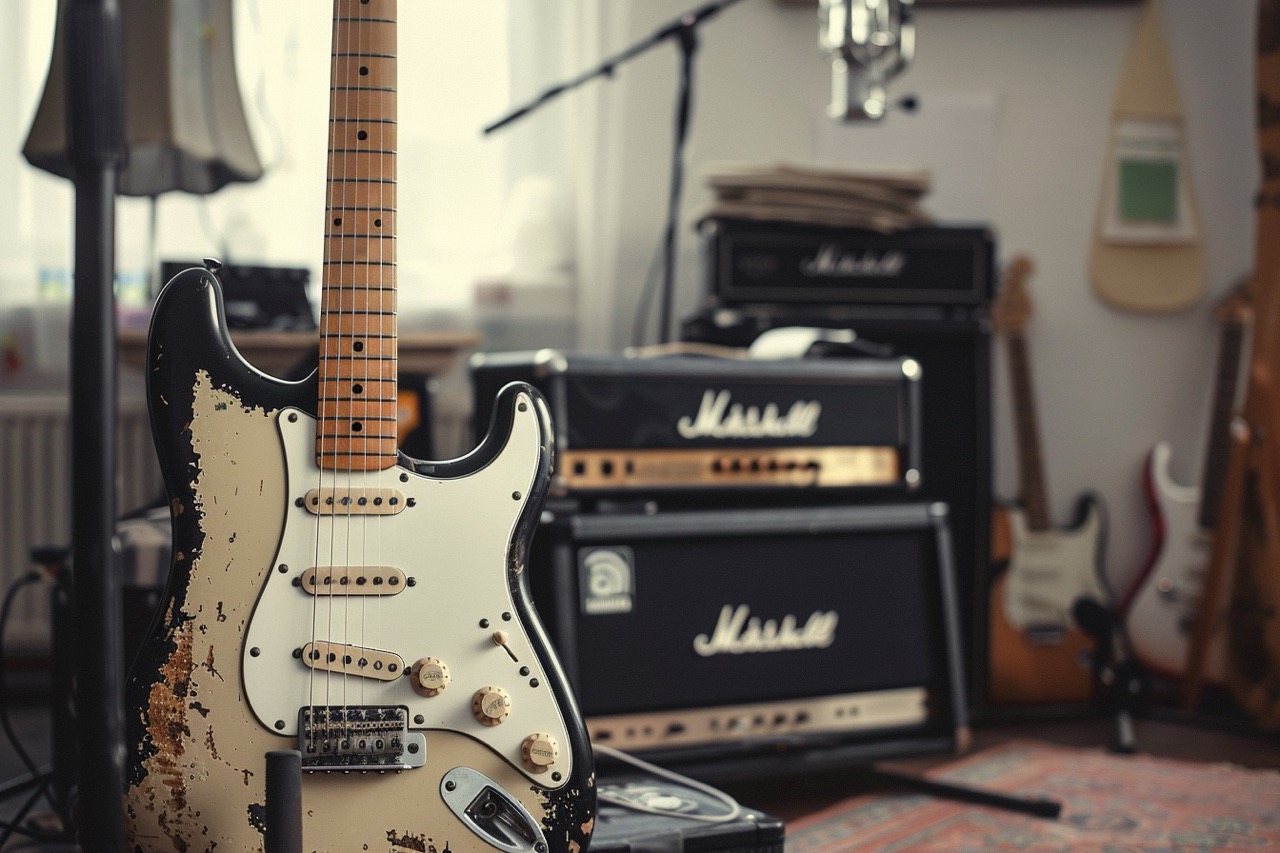
Tranquility Base: Vintage Keys, Warm Tones and Spacey Layers (2018)
If AM was noir minimalism, Tranquility Base Hotel and Casino was retro sci fi lounge music. The album moved away from guitar centred arrangements and embraced a broader palette built around pianos, vintage keyboards and atmospheric studio textures.
Chamberlin, Mellotron and Vintage Keyboards
Turner’s primary writing instrument for Tranquility Base was not a guitar, but a piano. He incorporated:
- Chamberlin
- Mellotron
- Wurlitzer
- Retro organs
These elements reshaped the harmonic world of the album and changed how guitars were used.
Soft Saturation and Low Gain Atmosphere
When guitars appear on the record, they are:
- Softer
- Cleaner
- Drenched in subtle reverb
- Used as texture rather than rhythm
Jamie Cook leaned heavily on:
- Gretsch hollow bodies
- Low wattage amps
- Tape style saturation
The result is an album where guitars are supportive, understated and atmospheric.
Studio as Instrument
James Ford and Turner approached the record like a cinematic environment rather than a rock album. Production included:
- Layered keys
- Reverbs with colour
- Analog inspired preamps
- Tape effects
- Soft, warm miking techniques
Tranquility Base might not be a guitar forward record, but its guitar work is among the band’s most tasteful and mature.
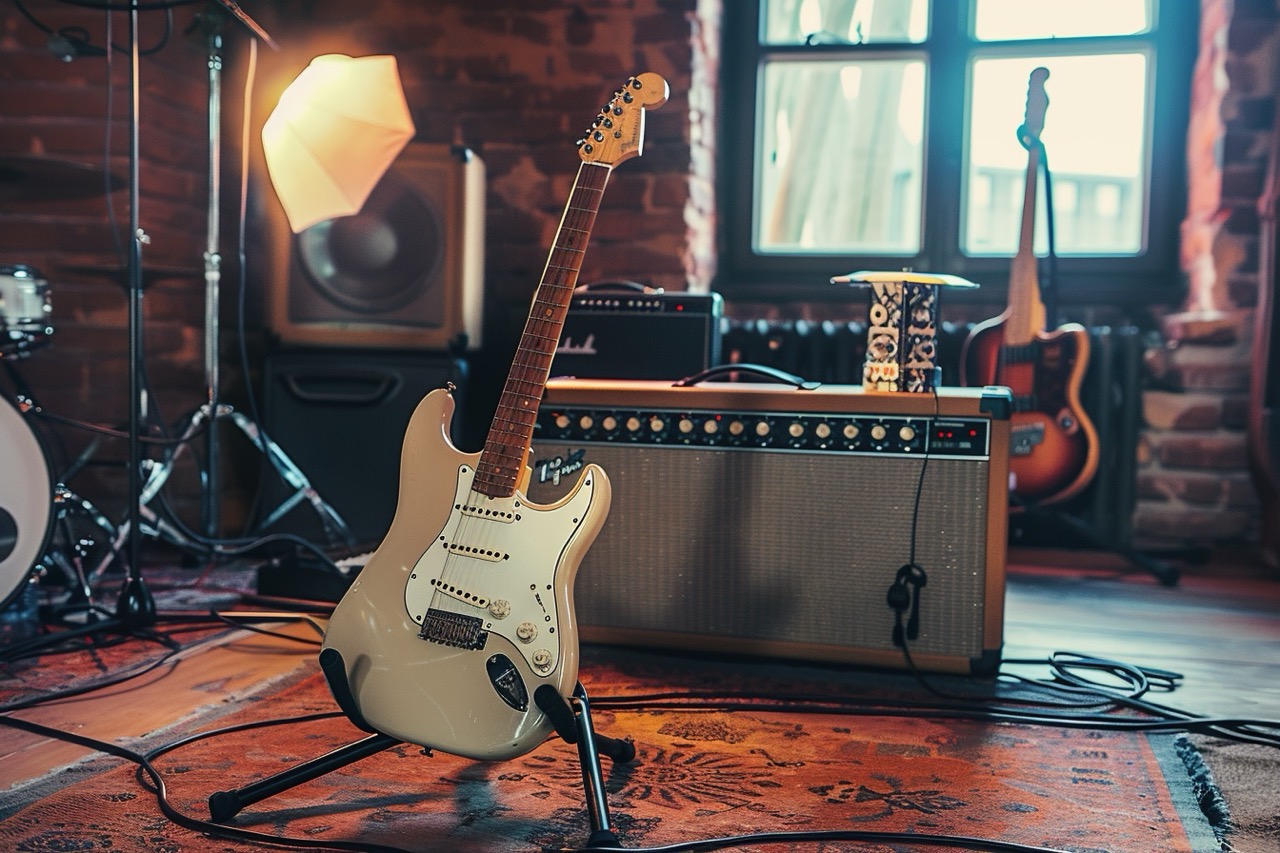
The Car: Cinematic Arrangements and Retro Studio Colour (2022)
With The Car, Arctic Monkeys reached their most sophisticated sonic evolution to date. The album sounds like a 1970s film score blended with smooth lounge pop, and the guitar tones reflect that refined, cinematic approach.
Orchestra Layers, Ribbon Mics and Vintage Preamps
Guitars on The Car sit beneath a rich tapestry of:
- Strings
- Brass
- Layered vocal harmonies
- Atmospheric keyboards
This required softer, rounder guitar tones. Ribbon microphones such as the Coles 4038 were often used for warmth, while vintage preamps added colour and subtle saturation. On this album, the guitar becomes part of the cinema, not the lead role.
Softer Guitars and Bigger Rooms
Turner and Cook used:
- Fender Jazzmasters
- Epiphone Casinos
- Gretsch hollow bodies
- Warm overdrives
- Low gain settings
The goal was texture, not attack. Guitars feel velvety smooth, warm and understated, supporting the vocals and arrangements rather than dominating them.
Alex Turner’s Crooner Vocal Chain
Turner’s vocal chain on The Car had a significant influence on the overall mix. His voice was recorded with:
- Neumann microphones
- Analog style preamp saturation
- Subtle plate reverb
- Gentle compression
This gave his voice a smoky, cinematic quality that shaped the tonal space guitars needed to occupy. The Car is not a guitar heavy album, but its guitar tones are some of the smoothest and most emotionally refined in the band’s catalogue.
Alex Turner’s Essential Guitars
Alex Turner changes guitars as often as he changes eras. Each one is chosen deliberately for its tone, personality and aesthetic. Here are the models that have shaped his sound across the band’s evolution.
Fender Jazzmaster
Used extensively in:
- AM
- The Car
- Live performances throughout the 2010s and beyond
Why he loves it:
- Warm midrange
- Smooth top end
- Perfect for noir style riffs
Fender Stratocaster
Turner used Strats frequently in the early albums and during AM era live shows. Their brightness and versatility make them a natural fit for cleaner parts and sharper attack.
Gretsch Guitars
Turner used Gretsch models heavily on:
- Submarine
- Suck It and See
- Tranquility Base Hotel and Casino
He loves Gretsch for:
- Vintage chime
- Dreamy warmth
- Sparkling cleans
Hofner Club and Violin Models
A defining AM era tone, especially for thick, short scale punch. These guitars add woody midrange presence and help create the signature noir feel of the album.
Acoustic Guitars
Turner has used a range of acoustics, including:
- Gibson J 45
- Gibson Hummingbird
- Martin acoustics
These appear throughout the band’s softer eras and soundtrack projects.
Jamie Cook’s Gear and Secret Weapons
Jamie Cook is the architect of Arctic Monkeys’ rhythm and texture. His gear choices evolve constantly, but a few instruments and amps have become trademarks of his playing.
Gibson SG
Perhaps Cook’s most iconic guitar. He used it extensively throughout Favourite Worst Nightmare, Humbug and AM era live shows. Its punchy midrange and aggressive bite make it perfect for driving rhythms.
Fender Telecaster
Clean, sharp and perfect for indie rhythm work. Cook’s Telecaster tones were crucial to the tight, bright sound of the early albums.
Custom Offsets
Cook often uses modified offset guitars for both studio and stage work, allowing him to shape tones that blend clarity with character.
Amplifiers
His go to amps include:
- Orange AD30 for mid heavy punch
- Fender Twin for bright cleans
- Vox AC30 for chime and breakup
Cook’s secret weapon is his rhythm precision. He drives the band’s grooves with tight, propulsive accuracy that complements Turner’s riffing perfectly.
Pedals and Effects: The Colour of the Monkeys’ Sound
Overdrives and Distortion
The band’s signature dirt tones come from a handful of classic pedals, including:
- Fulltone OCD
- Big Muff fuzz
- Pro Co Rat
- Tube Screamer
- Tone Bender clones
Delay, Reverb and Modulation
Arctic Monkeys use effects sparingly but effectively. Subtle enhancements include:
- MXR Carbon Copy
- Strymon BlueSky
- Boss DD series delay
- Electro Harmonix Memory Man
Live vs Studio Differences
The band’s live tones differ noticeably from their studio tones.
Live tones are:
- Dirtier
- Drier
- Louder
- More compressed
Studio tones are:
- Layered
- Cleaner
- More detailed
- Frequently double tracked
The key to Arctic Monkeys tone is this: don’t overuse pedals. Let the amps and the playing do most of the work.
Studio Magic: Producers, Microphones and Techniques
James Ford: The Master Architect
James Ford’s influence is present on nearly every album since Favourite Worst Nightmare. He pushes the band toward:
- Clarity
- Contrast
- Warmth
- Cinematic production choices
Josh Homme: The Desert Catalyst
Homme introduced the band to a darker, thicker sonic world during the Humbug sessions. His contributions include:
- Fuzz
- Heaviness
- Darkness
- Space
- Attitude
Humbug is his sonic fingerprint on the band’s evolution.
Microphone Chains and Tracking Techniques
The band frequently uses classic chains for capturing guitar and vocal tones:
- Shure SM57 on guitars
- Royer R121 ribbon mics
- Neumann U87 for vocals
- Coles 4038 ribbon mics for room ambience
A signature of their production is double tracking guitars, panned wide, with subtle differences in tone to create richness and depth.
The real secret to their sound is dynamic contrast — quiet verses leading to explosive choruses, controlled through thoughtful arrangement and production.
How to Recreate Arctic Monkeys Tones Live
Whether you're a gigging musician, a studio player or part of a tribute act, here is the blueprint for capturing the Arctic Monkeys sound across their eras.
Early Albums Tone
- Telecaster or Strat
- Orange AD30
- Light overdrive
- Fast, tight rhythm playing
Humbug Tone
- Gibson SG
- Big Muff fuzz
- Darker EQ settings
- Slower picking and wider intervals
AM Tone
The holy grail tone, and the most requested.
- Fender Jazzmaster
- Vox AC30
- Clean tone with breakup on heavier hits
- Minimal delay
- Tight rhythmic pocket
The Car and Tranquility Base Tone
- Gretsch hollow body
- Very light gain
- Soft reverb
- Warm, mellow EQ
Most important tip: Arctic Monkeys tone is roughly 60 percent gear and 40 percent playing style. Feel, touch and rhythmic control matter just as much as equipment.
Tribute Culture and Artificial Monkeys
Artificial Monkeys don’t just perform Arctic Monkeys songs. They recreate the tones, the energy, the stage presence and the atmospheric feel of each record.
Their live rigs include accurate recreations of:
- Fender offsets
- Vox and Orange amps
- Jazzmaster tones from AM
- Humbug era fuzz
- Tranquility Base retro warmth
Fans often say the band sounds closer to early AM than the real band do today.
👉 Book the UK’s most authentic Arctic Monkeys tribute band here
FAQs
What guitars do Arctic Monkeys use live?
How do I get the AM album guitar tone?
What pedals does Alex Turner use?
What amps does Jamie Cook prefer?
How did Josh Homme influence Arctic Monkeys sound?
What keyboards does Turner use on Tranquility Base?
Where can I hear AM tones recreated live?
Sources and Further Reading
- Fender
- Premier Guitar
- Reverb.com Arctic Monkeys gear guides
- NME interviews
- Domino Records studio notes
- James Ford producer interviews
Book the Artificial Monkeys for your venue or event. Call 07897 020817 or click the link below.
👉 Book your Arctic Monkeys tribute show here